| MUSIC from the ANDES...and
nearby regions
Español
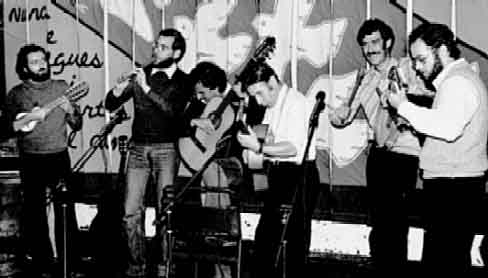 This
site now has a consultant - Paul Farren of the London based group
Achalay. From left to right: Gregorio (Goyo) Melnick, Ricardo Yocelevsky,
Egberto Bermudez, Paul Farren, Peter Matthews, and Ian Mursell. This is the
group that performs 'Añoranzas' and 'Yaravi' in the group of selections. This
site now has a consultant - Paul Farren of the London based group
Achalay. From left to right: Gregorio (Goyo) Melnick, Ricardo Yocelevsky,
Egberto Bermudez, Paul Farren, Peter Matthews, and Ian Mursell. This is the
group that performs 'Añoranzas' and 'Yaravi' in the group of selections.
"Like you, I just love this music, and
I'm delighted to have the opportunity to help people to hear it" - Paul
Farren
I've gotten many requests to have
more information about the music, so here are many examples
representing Argentina, Ecuador, Bolivia, Colombia, Peru, Venezuela, and
Uruguay with comments by guitarist Paul Farren (see picture) -
Jim
NIÑA, BAILA LA
ZAMBA - Argentino Luna
and group//Argentina (Agave SDL 27014)
The zamba - pronounced like 'Samba' - couldn't be more different. This is
the national dance of Argentina, a courtship dance for couples, each waving
a white handkerchief. He sings to his girl urging her to dance the zamba and
telling how it thrills him to see her dancing. Being Argentine, it's very
stately
CHIMBALOMACHIMBALOMA
- Boliviamanta//Ecuador (A.S.P.I.C. As 13.01)
Boliviamanta means both "from Bolivia" and "Made in Bolivia" in Quechua.
It's a mixed group of Bolivians, Peruvians and Ecuadorans. This is so
Ecuadoran and features the rondador, the national instrument of that
country.
MINERO
- Savia
Andina//Bolivia
DOLOROSO
- Altiplano//Bolivia (EUCD 1416)
This is a "cacharpaya", a song of farewell, often sung and
danced at farewell parties for the teenage lads who are leaving the
village to seek their fortune in the big city. Words such as
"Adios, my dear village...God knows when I'll see you again"
are common. This one is about the parting of lovers - "such a long
time of enchantment came to nothing....". The cacharpaya is also
used as the last dance of the evening.
POLO DOLIENTE
- Inti-Illimani//Venezuela
The very famous Chilean group, Inti-Illimani, had a fine
Venezuelan musician with them for a while; he can be heard on harp.
The polo comes from Margarita Island (Venezuela) which - until the
recent tourist boom - lived by fishing. Many polos have words which
tell of fishermen lost at sea. This one tells how four men set
sail to fish last night...now they are being buried....and after the
funeral we can see oars floating on the water. This is typical of a
very peculiar aspect of Latin American music - from Puerto Rico to
Tierra del Fuego: very sad words sung to very bright and
happy-sounding music - and the same in reverse. They've mixed in a
joropo with this polo; usually the polo is more gentle. When we
visited Margarita Island, it became known to the hotel musicians that
I knew about their music. They announced that this polo was dedicated
to me and proceeded to sing a beautiful polo telling how their island,
once an unknown fishing community, now welcomed visitors from all over
the world. I sat almost in tears as they sang their song for me. When
my Venezuelan friends in London had played me scratchy old 78 rpm
records of polos, I didn't dream that one day I would be on Margarita
having one specially played for me.
AÑORANZAS
- Achalay//Argentina
A chacarera doble played by my own group, Achalay. I open the
piece on guitar and play the bits between the verses. It's a very
chauvinistic song where the singer grumbles about all things modern
and yearns to be buried in his native Santiago del Estero - the
province from which the chacarera comes. It's a long song, but the
words
are interesting.
SAN JUAN de
IMBAQUINGO - Jatari//Ecuador
CANTO DE AMOR
- Luis Anibal Granja/ensemble//Ecuador
(Granja LP.351-0024)
The melody alternates between the harp and the requinto, which is
the name in Ecuador for a guitar with a section cut away to enable the
player to reach the highest frets. It often has a metal top-string.
CUANDO MUERE el
ANGELITO Argentina (RCA ND 70168)
Another sad song to bright music. I have a sung version of this which is
heartbreaking. I'ts sung by a woman asking why her tiny baby - the
'angelito' , so innocent and without sin, should have died. The bovine
noises are made by the erke (or erque), a long thin tube stuck into a ram's
horn, ie, an alpenhorn. My friend brought one back from Argentina. He had
to take it with him into the cabin of the airplane, lie it along the edge of
the gangway and constantly watch to see that no-one trod on it!
ALLÁ VIENE el
CORAZÓNALLÁ VIENE el
CORAZÓN -
Inti-Illimani//Venezuela
Another by Inti-Illimani when they had a Venezuelan member. This time he
plays cuatro. I included this so that you could hear the 'mina' - see
'Barlovento' on the first page. All the drumming sounds come from the same
log.
MILONGA
- El Faustin Argentino (The
Argentine Faust)//Argentina (BMG BM 650)
There are two types of milonga; that sung by gauchos of Argentina and
Uruguay to their own guitar accompaniment and this type for dancing in
Buenos Aires and Montevideo.
GASTO YAUICUY
- Karu Nan//Ecuador (TUMI CD 027)
The huayno is Peruvian, but this one is very Ecuadoran.
AMANACER
(Daybreak) - Eduardo Fernández//Colombia
(Decca 443 999-2)
A guitar
solo in the rhythm of the Colombian national dance, the bambuco.
SABANA BLANCA/MOCHO
HERNANDEZ -
Soledad Bravo//Vnz. (Buda
B000001N7S)
Sung by a
Spanish artiste who specializes in Venezuelan songs, the main accompaniment
is on the bandola, a 4-stringed mandoninish instrument. Listen how he plays
melody and accompanies himself rhythmically in the bass....all on 4 strings!
BOQUERÓN
ABANDONADO -
Zulma Yugar//Bolivia
This is typically Bolivian, totally relaxed and laid-back. Boquerón was a
fort during the Chaco War between Bolivia and Paraguay where 600 Bolivians
were besieged by 15,000 Paraguayans. The Paraguayans could only take the
fort after 20 bloody days and at one point were on the brink of defeat. Some
200 Bolivian survivors were paraded through the streets of Asunción, where
it was expected they would be lynched, but the Paraguayans bowed to them
respectfully.
PRELUDIO
PAMPEANOPRELUDIO
PAMPEANO - Dúo Pomponio
Zárate//Argentina (Mandala Man 4804)
Argentine husband and wife classical guitar duo.
VERBEÑITA
-
Savia
Andina//Bolivia
LAS MIRLAS
- Conjunto de Oriol Rángel//Colombia (Universidad de Los Andes)
The words say 'Cantan las mirlas por la manaña'....(The blackbirds sing in
the morning), which is silly; It's the male birds (los mirlos) who do the
singing. Still, it's a lovely example of the Colombian national
dance-rhythm, the bambuco. The trick is not to play the first beat of every
bar.
DE CAMPO AFUERADE CAMPO AFUERA
- Suma Paz//Argentina (EMI 4 93379 2)
Suma Paz sings so well and accompanies herself beautifully on the guitar.
The words - about the pampa - are beautiful too.
LA del CAMPO
- Atahualpa Yupanqui//Argentina
"The Country Girl", a chacarera played as a guitar solo by the famous
Atahualpa Yupanqui - guitarist, composer, singer, author and folklorist.
LA NARANJALA NARANJA
(The Orange) - Trio Los
Chasquis//Ecuador (A.S.P.I.C. X55520)
A beautiful popular song from Ecuador, very well arranged.
LA
ROSA y el CLAVELLA
ROSA y el CLAVEL -
Hugo Lagos y cjto//Chile (ALCE 509)
A typical Chilean cueca - their national dance. The singer
prefers the carnation (el clavel) to the rose, which he finds too
sissy (It takes all sorts.....)
VIVA
JUJUY - Jaime
Torres and ensemble//Northern
Argentina (Philips 9020)
Group
led by the Argentine/Bolivian virtuoso of the charango (small 10-stringed
instrument made from the shell of an armadillo), Jaime Torres - or Jimmy
Towers if you prefer. This is in the rhythm of the bailecito, a lovely dance
of courtship originally from Bolivia but also popular in Northern Argentina.
CHIQUIT GUAMBRITACHIQUIT GUAMBRITA -
Los Calchakis//Ecuador (Philips 9020)
"Guambrita" is Ecuadoran quechua slang for an indian girl.
This very nice arrangement includes all the best instruments: harp,
quenas, rondador, charango, etc.
SERENATA
- Berenice Chávez
y Los Provincianos//Colombia (Philips BL 7777)
Lovely Colombian bambuco. It was recorded about 40 years ago, and they
didn't get the balance right. Consequently, the singer is sometimes
drowned out by her accompanists.
ITALIANOMASICUNA
-
"Trencito de los Andes -ZigZag//Ecuador
"Italian Guys". I love this unusual Ecuadorean record. It finishes with two
rondadores (the national instrument of Ecuador) tuned an octave apart- very
effective. It also contains two rustic folksongs and a clarinet. OH
yes...and two kids. "Trencito de los Andes" is a musical institution Founded
by Raffaele M. Clemente and his brother Felice M. Clemente. We thank
Raffaele for writing us with this information. If you see this CD: buy it!
It's full of good things.
SIETE
LEGUAS (7
leagues) - Rafael Arias Paz y cjto//Bolivia
Utterly typical "cuequita boliviana" played by a group led by a fabulous
guitar-player. All very relaxed and Bolivian.
DOÑA
SOLEDAD -
Zitarrosa//Uruguay (Odeon LDB-151)
Uruguay has always felt itself squeezed between the giants, Brazil and
Argentina, and it shows in this piece. We have the negro drumming influenced
by Brazil, and the gaucho guitars from the Argentine side. The singer
castigates this woman Doña Soledad for her lifestyle - sleeping around,
quarrelling over a bit of meat in the market, drinking too much, etc. He
warns her she'll find herself in an early grave without the price of a
coffin.
PARASPARAS
- Expresión//Peru
On the theme of "harvest".
QUISIERA
TENER CIEN PESOS (I wish I had 100 pesos) - Isabel Parra//Chile
...because, the singer tells us, then all the local boys would be after her.
This is Isabel Parra, a truly fine Chilean artiste, daughter of the famous
folklorist Violeta Parra. It's a very rustic and very truly Chilean cueca.
BAILAR,
BAILARBAILAR,
BAILAR -
Inti-Illimani//Ecuador
EL
HOMBRE - Martina
Portocarrero//Peru
Peruvian protest-song which praises the man who won't bend the
knee to the tyrant. Very Peruvian, with a cajón (literally 'big box',
which is what it is; the drummer sits on it and plays it with his
hands_). Like all such Peruvian songs, this one has a coda in which
the singer sums up the whole thing. I saw Martina perform in London.
She had several hats, shawls and wrap-around skirts on stage, which
she changed into between songs. She explained that she can't sing a
song of Ayacucho wearing the costume of Puno.
MI
CHIQUITA -
Inti-Illimani//Peru
A lovely song from the negro tradition of coastal Peru.
DE
FIESTA EN FIESTA -
Peteco Carrabajal y Conjunto//Argentina (EMI 7 2434 96953)
A Chacarera. I like the interaction between piano and voice.
TONO
del DORMILÓNTONO
del DORMILÓN (Sleeper's Song) - ZigZag//Ecuador
Obviously from Ecuador and - like them - somewhat unusual but nice to finish
with.
|

